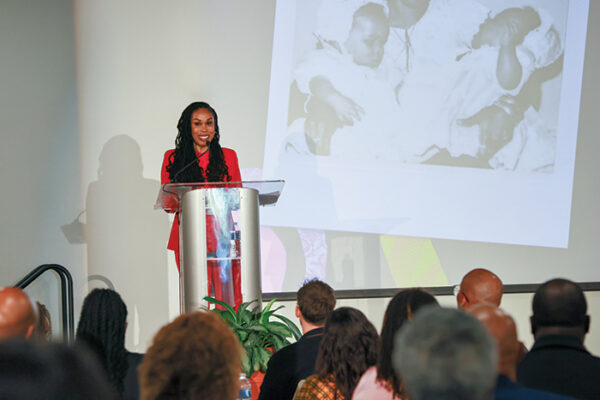
On a Wednesday evening in April, after their busy workdays ended, dozens of doctors and other clinicians poured into the Foundation for a Healthy St. Petersburg to hear from a best-selling author, Harvard-trained physician and one of Time magazine’s 100 Most Influential People in Health.
Dr. Uché Blackstock, author of the New York Times best-seller Legacy: A Black Physician Reckons with Racism in Medicine, spoke to the crowd about how healthcare and racism intersect—and what clinicians can do to improve outcomes.
The Foundation organized the evening believing that, while medical care is far from the only factor that shapes our health, clinicians have tremendous potential to improve patient outcomes and community well-being.
“We wanted to create a space for our local medical community to engage with a renowned industry expert around opportunities to elevate outcomes where we see the greatest need,” Foundation President and CEO Dr. Kanika Tomalin said. “Creating a community in which good health enables all people to thrive requires thoughtful reflection about where our systems fall short so that we can systemically improve them.”
As a young girl growing up in Crown Heights, Brooklyn, Blackstock dreamed of following in her mother’s footsteps to become a doctor. In the fall of 2001, at the age of 23, she took her place at Harvard Medical School (HMS), where her mother had also trained

.
While at HMS, Blackstock suffered a near-death experience that became foundational to her career. Experiencing intense abdominal pain, nausea and vomiting, she went to an emergency room seeking care. After a brief examination, she was told she had a stomach bug and was sent home, her pain dismissed. After her symptoms worsened, she returned twice to the ER before finally receiving the correct diagnosis of appendicitis. By that time, however, her appendix had burst, causing complications and a long recovery.
“Part of the reason I have the career I have today—making sure patients are listened to, that they are given care that is responsive to their needs and that physicians aren’t overlooking their pain simply because of the color of their skin—is due to that time spent as a patient, feeling vulnerable, scared and unsure,” she writes in Legacy.
In this generational memoir, Blackstock draws on her extensive medical career to illuminate the persistent inequalities in patient care and outcomes. She examines the many drivers behind these disparities, including affordability and access, racially biased medical instruments (devices that yield different results depending on a patient's race or ethnicity), race-based medical guidelines and the glaring underrepresentation of Black physicians in medical schools and hospitals.
A former associate professor of emergency medicine at New York University, Blackstock is the CEO of Advancing Health Equity, which partners with organizations to eliminate bias and discrimination in healthcare, cultivate an equitable organizational culture and improve health outcomes.
The Foundation, established in 2013, leads, funds, advocates and partners to create a community where everyone can live healthy lives. Its mission is to advance racially equitable health outcomes by improving the systems and conditions that shape them. It launched its Center for Health Equity in 2019. St. Pete Life is proud to partner with the Foundation to drive awareness of vital topics and celebrate the diversity of our community.
Visit healthystpete.foundation and ucheblackstock.com to learn more.