For many, Mahjong is a pastime inherited from grandparents, a centuries‑old tile game that’s been played for generations in communities around the world.
Boasting a long, intricate backstory, the tile-based game originated in China’s Yangtze River Delta region and traveled across cultures, changing as it went. In the U.S., the version popularized by the National Mah Jongg League introduced structured hands, annual cards and the now-essential joker tile, creating a faster, more social style of play. For decades, it held a strong foothold in Jewish communities, where the game became as much about gathering as gameplay.
Today, that same social energy is appealing to a more diverse group of players, where it’s as much about conversation, snacks and laughter as the tiles themselves. For me, it was something entirely new—discovered at card tables tucked into church halls, cafes and clubhouses, then carried home and shared again.
I can thank Lynn Denson, a former neighbor, for getting me into “Mahj,” as I call it. After texting to invite me to a no-cost, four-week beginner program she was starting on behalf of our church, I couldn’t get to Monsignor Caverly Hall fast enough. I’m a joiner. Joiners aren’t intimidated by a roomful of card tables strewn with mountains of mysterious tiles.
Sure, I stumbled. One week I even ended up with six jokers and still didn’t manage to call Mahjong. But the missteps were part of the fun and the social energy in the room made every session feel like a party disguised as a lesson.
As soon as that class wrapped, I typed “St. Pete Mahjong tutor” into a search engine and up popped Gaia Banovich. Like me, she’s a transplant from New York City. Unlike me, she’s a Certified American Mahjong Instructor and has crafted her own “Mahjong Made Simple” teaching method. I happily splashed out on her “Intro to Mahjong” and “Mahjong 102” semi-private lessons and then bravely ventured into an organized competition she was putting together under the auspices of The Mahjong League.
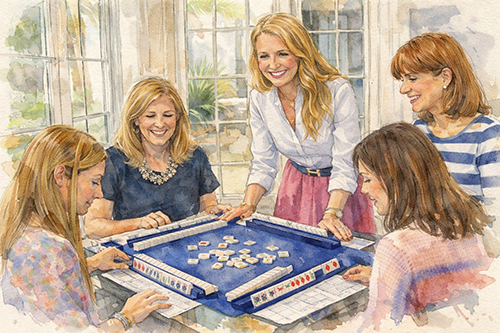
Yes, mere months after I’d racked my first tile, I signed up for the first-ever Tampa/St. Pete chapter of this national-in-scope league. For eight weeks—give or take a session or two I missed for work-related travel—I parked my tush at the beginners table in the back room of Pour & Décor on Central Avenue and dove in.
I honestly didn’t care that I was always—always!—at the bottom of the weekly league leaderboard. I was learning, my fellow players were hilarious, and Pour & Décor has some delicious baked goods to snack on. Wine, too, of course. But after seeing one gal elbow a glass of vino off the tiny table and send it crashing to the floor, I decided the Sauvignon Blanc could wait for later.
Around me, the room told a bigger story. Players of different ages and backgrounds gathered at tightly spaced tables, learning the rhythms of the game together. Some were longtime enthusiasts. Many, like me, were brand new. What we shared was less about skill level and more about the draw of the experience itself. That mix—gameplay, conversation, a little food and a little chaos—is what makes Mahjong so appealing. It’s structured enough to be challenging but open enough to invite personality, in a city that thrives on connection.
Recently, my Mahj journey has led to my very own dining room, where I hosted the beginners’ group from the Crescent Heights Neighborhood Association. I also play regularly at my home-away-from-home, the Racquet Club of St. Petersburg. The weekly gathering started by Darcy Giroud takes place at the club’s restaurant, Root + Clay. It is a melting pot of disparate playing styles. While the National Mah Jongg League has issued rules we’re supposed to follow, rest assured there’s plenty of rogue activity at tables all over town.
Just like the multiple spellings of Mahjong, there clearly isn’t one “correct” way to learn this centuries-old game. I’m just happy that I did kinda sorta learn it, even if I’ve only gleefully shouted “Mahjong” once in this entire first year. Every time I play, I dial in just a little bit more.
A few months ago, I tore open the envelope from the National Mah Jongg League bearing my 2026 card—the cloak-and-dagger details of which had been filling my Instagram feed for weeks—and I was shocked at how far I’d journeyed over the past year, from clueless newbie to borderline-cocky newbie.