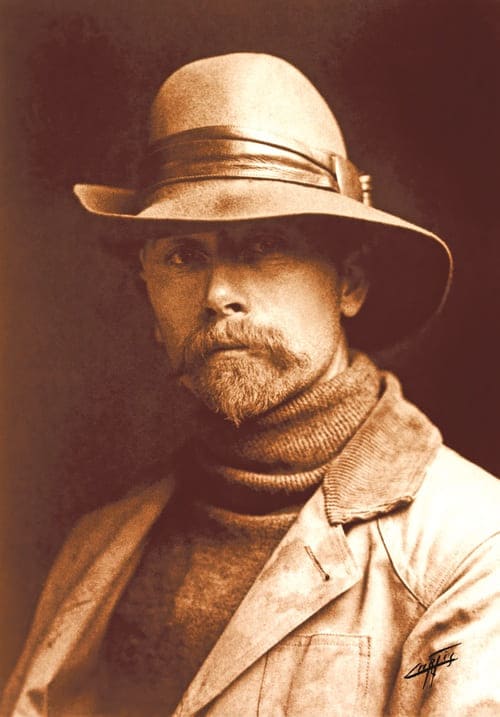
Picasso, Michealangelo, Dali, John James Audubon. The work of certain artists is instantly recognizable. Other artists may not have the name recognition, despite voluminous ground-breaking work. American photographer Edward S. Curtis (1868-1952) is of the latter, one of the early 20th century’s most famous photographers, yet an unsung hero in modern times.
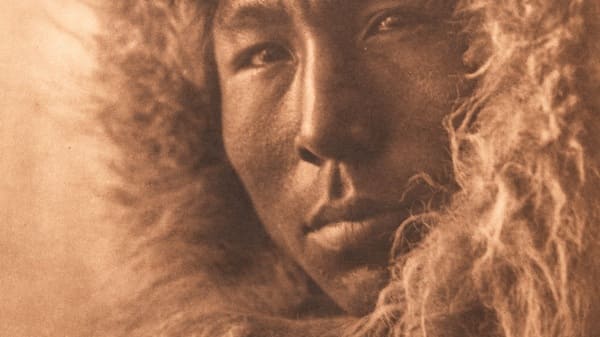
His iconic work documenting Native American people and tribes was an extraordinary undertaking in the early 1900s. Sometimes referred to as the "Shadow Catcher," Curtis traveled the Western United States and Canada to document the dwindling ways of life of some 80 native tribes through photographs and audio recordings. The project, which continued for three decades, resulted in 20 volumes with 1,500 photographs.
The James Museum of Western and Wildlife Art will pay homage to him in a new exhibit that opens November 8th, Edward S. Curtis: Photographer of His Time. Lucky for us, The James holds one of the largest collections of Curtis photography—some 1,100 images in the Robb and Susan Hough Edward S. Curtis Collection.
Associate curator Caitlin Pendola presents a look at some 164 images focusing on the evolution of Curtis’s photography from 1897 to 1927 in relation to shifting artistic and cultural movements of the era. From romanticism and pictorialism in his early years, to modernism and regionalism later on, the viewer can explore a unique window into the changing landscape of American art and culture.
Pendola shares that the photographs are accompanied by several works that put Curtis in context with other artists of his period.
“These additional works by his contemporaries help to portray the time period and everything that was going on during this 30-year time period,” she explains. “I think Edward Curtis was rather well known during his life, but over time he lost that recognition.”
His story is one of a pioneer and adventurer, an ambitious workaholic with a keen desire to record living history at all costs. Based from his Seattle home, with no formal education or training, Curtis was offered a job as official photographer of the Harriman Alaska Expedition of 1899 and shortly after was invited to join an expedition to photograph people of the Blackfoot Confederacy in Montana in 1900. His work was recognized by legendary financier J.P. Morgan who, in 1906, provided Curtis with $75,000 to produce a series on Native Americans.
Curtis understood the importance of this opportunity, which became his life’s ambition. His epic undertaking, The North American Indian, spans 20 volumes of narrative text and photogravure images, each accompanied by a portfolio of large photogravure plates. The project set him on a race against time. In the introduction to the first volume, published in 1907, he wrote, “The information that is to be gathered…respecting the mode of life of one of the great races of mankind, must be collected at once or the opportunity will be lost.”
“Similar to creating a movie set, Curtis required a production crew who had to work out logistics and written contracts in advance of every photo shoot,” Pendola elaborates. “He required native interpreters and photography assistants and paid them all.”
In all, he produced a total of some 40,000 photographs and made over 10,000 wax cylinder recordings of Native American language and music. His work was controversial among ethical critics who accused him of staging and romanticizing a vanishing era and race, often disregarding signs of modernization within the tribal lifestyle.
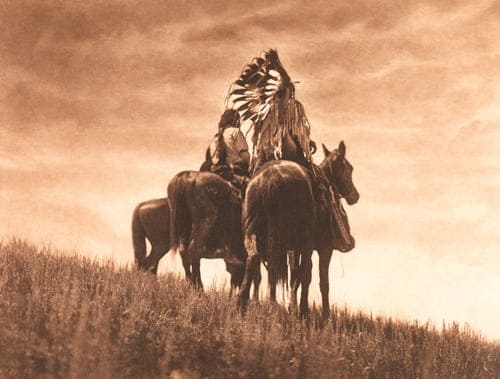
Indeed, Curtis went to great lengths in the planning and execution of his images with thoughtful composition and attention to authentic detail. As seen in the exhibit, the sepia-toned images appear staged or posed, usually as portraits or depicting scenes of daily life. For example, Cheyenne Warrior (1905) portrays two men on horseback, one in full headdress, gazing out over an open prairie. In Hóṇovi—Walpi Snake Priest with Totókya Day Painting (1900), a powerful figure in white body paint, tribal dress, shells and feathers stares coldly into the lens.
In one gallery installation, Pendola and co-curator Ernest Gendron display a collection of 84 portraits. As Pendola explains, it’s actually an ongoing research project.
“We have one portrait per tribe and are working very hard to research each one. Curtis provided minimal descriptions, often not naming the subject. So, we decided to make this a living research project and are asking the public for help in identifying each one,” she explains. “Ernest has done a lot of research already, reaching out to people and organizations across the country.”
Most of the remaining complete sets of The North American Indian are in libraries, museums and private collections. While Curtis devoted much of his life to preserving history, personally he often faced financial strains, bankruptcy and ultimately died in poverty in Los Angeles in 1952.
Edward S. Curtis: Photographer of His Time will run through March 29th. A number of associated events and additional programming are planned. For more information, visit thejamesmuseum.org