Photography by Skyler June
It would be easy to overlook the gate in the somewhat unassuming fence that stretches along the quiet, mostly residential, street leading to the farm, even with the hand-painted sign bearing its name above a rustic archway. It’s only after you’re on the other side of the fence, navigating a thicket of fruit trees along the sun-dappled garden path, that you catch sight of a few figures working silently and purposefully in the field and notice a shaded pavilion lined with simple farm tables. There’s a serenity to the scene, even with a couple of children and a dog buzzing about.
The children, the dog and the welcoming smile that greets us belong to Meredith Pericles, founder of Do Good Day—a St. Pete event that connects local nonprofits with the community to showcase their missions and recruit volunteers. Produced by her Do Good & Shine Brightly Foundation, the event operates like a career fair for nonprofits, allowing organizations including the farm to highlight their missions and engage volunteers. Today, she’s wearing her director of events hat for the farm—another vitally important nonprofit.
Pericles’ husband John is also on the scene, busying himself with various chores. In fact, they all seem to be so accustomed to having visitors at the farm and are absorbed in their tasks—including gathering ingredients from the garden for the meal being prepared—that they often slip away mid-conversation, only to reappear moments later with handfuls of colorful flowers or herbs for the chef.
The farm has a half-acre of cultivated land—which may not sound like a lot, but it produces more than 8,000 pounds of fresh, organic and locally grown produce a year, including 50 varieties of vegetables, greens, edible flowers and fruit, all hand tended by a small crew.
Committed to sustainability, the farm avoids chemical fertilizers and pesticides. It instead embraces regenerative organic practices that turn farm waste into nutrient-rich compost and relies on the natural balance of the soil ecosystem.
What began in 2010 as a small therapeutic garden on the grounds of the former Faith House rehabilitation center has grown into one of St. Pete’s most inspiring community farms. Led by founder and president Emmanuel Roux, who, along with a group of volunteers, transformed a few vacant lots into a thriving source of fresh, nutrient-rich food. Roux, a longtime local restaurateur who previously operated several popular restaurants and is the owner of GateauOChocolat, has championed urban agriculture as both a chef and advocate.
After Faith House lost federal funding in 2016, the farm was revived when social entrepreneur Mark Hunter joined Roux to reimagine it as a hands-on educational hub. That same year, then–Tampa Bay Times food critic Laura Reiley published an investigative series titled “Farm to Fable,” exposing the widespread practice of Tampa Bay restaurants—many in St. Pete—making false “locally sourced” and “farm-to-table” claims, concluding, “You’re being fed fiction.”
By 2024, a multi-year expansion—including a 2,000-square-foot commercial kitchen, a wood-fired brick oven and event space—transformed the farm into an urban oasis in the heart of downtown.
Rooted In Good
Rather than operating as a traditional restaurant, the farm hosts event-based dining through farm-to-table dinners, tastings, cooking classes and monthly yoga sessions followed by breakfast—all available for sign-up on the farm’s website. These gatherings embody the farm’s mission to nourish both body and community.
“Everybody sits at long tables and everything is served family style,” Roux explains. “Because food brings people together. We offer a culinary experience that is also a cultural experience and a social experience. Our mission statement is that we facilitate learning and community building around good food.”
The urban educational farm also grows community through its mission to facilitate learning and community building about healthy food “from soil-to-fork.” The farm has collaborated with more than 17 schools to create gardens where students can learn about food production and sustainability. It also works closely with the University of South Florida (USF) to offer educational programs and hands-on learning opportunities for students of all ages—from preschoolers to medical students—onsite and across Pinellas County.
Volunteers and students play an active role in the farm’s daily operations, helping sustain its mission.
Fueled by grants, donations and revenue from special events, 15th Street Farm has become a vibrant model of sustainability and community connection, including providing access to healthy food for families of expectant and new mothers in South St. Pete neighborhoods.
The farm also regularly participates in community events and partners with other nonprofits such as the Do Good & Shine Brightly Foundation, the Boley Centers and CASA, as well as with the city and USF in a composting initiative.
Bearing Fruit
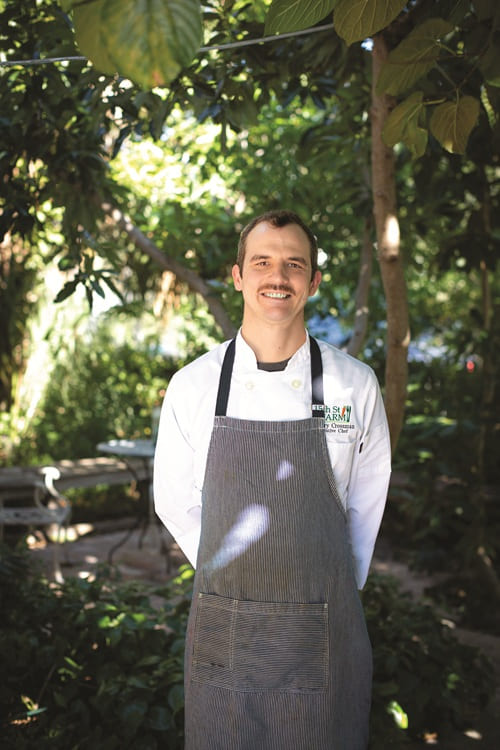
In April, Chef Zachary Crossman was appointed head chef, bringing with him a global palate and passion for local culture.
Originally from Massachusetts, Crossman earned his culinary degree in Rhode Island before expanding his perspective through travels across Europe, including Ireland, Paris, the Netherlands and Greece.
He settled in Florida more than 10 years ago to be near family and soon became active in the region’s food community. His experience includes culinary work with Lowry Park Zoo, at Wat Thai Temple helping run their Sunday market, and an ongoing role as a corporate chef with Suncoast Food Brokerage, which links food manufacturers offering a wide range of products—including pasta, beef, pork, seafood, cheese and various plant-based options—with distributors and operators including restaurants, hotels and caterers.
Initially joining 15th Street Farm as a guest chef, Crossman’s leadership, artistry and shared commitment to the farm’s mission quickly made him central to its success. He’s known for artful plating and globally inspired menus that draw primarily on items harvested from the farm, complemented by thoughtfully sourced ingredients. Beyond the kitchen, he’s an accomplished ice carver who has competed in national events in Indiana for the past three years.
It seems that everyone here wears many hats.
“This is our tasting platter,” explains Pericles, as she carries a platter out from the kitchen, piled with intriguing delicacies arranged around triangles of homemade sourdough bread atop a bed of dark green leaves. “Guests would typically start with this and tea service in the garden.”
The tea is made from flowers harvested from the garden. Today, we are treated to a butterfly pea flower blend that turns purple when a slice of lemon is added.
“We grow the flowers along the fence line and brew the teas,” Crossman offers. “We'll have volunteers come in and help us harvest. We dehydrate them, for when they're out of season. We also do hibiscus orange blossom tea and a butterfly pea rose water.”
Turning our attention back to the tasting platter, Crossman guides us through the offerings.
“This is obviously a share plate. We do our own homemade pickles, sauerkraut, jams and jellies,” he says. “We have fig trees all over the garden, so that's where the fig jam came from. We make our own pickles and sourdough bread. And this is an African spice beef jerky called biltong made with black pepper, coriander, salt and apple cider vinegar. We dehydrate it and slice it thin. Our founder is French but spent a lot of time in Morocco and South Africa. It's one of his favorites.”
From sweet and spicy to savory, the sampling is deliciously diverse and the unexpectedly delicate yet flavorful house-made sauerkraut is a standout.
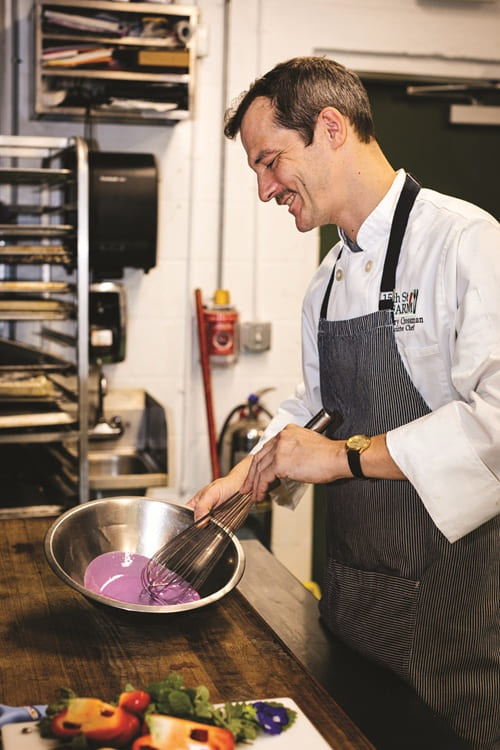
“The sauerkraut is a labor of love. My background is primarily Greek, but there is also a little bit of German in there. I also have a big influence from the Thai community in there as well. I worked with the temple for five years. I was very fortunate when I first moved to Florida to become good friends and part of the family with the ladies at the temple. I had a lot of aunties and grandmas, who kind of adopted me. It was love at first sight with me and those ladies,” he enthuses. “We resonated with each other on a deep, emotional level and then they invited me over to the temple. I slowly learned and, a couple months later, I was helping them run the show.
With the sauerkraut, I try not to make it too pungent but still have some of the healthy gut probiotics in there to help with digestion. That's kind of our focus here with all the things we do. We try to make them health conscious and promote good gut health. Everything reacts to what's going on in your gut, whether it's your mood or what your body is telling you.”
“On a typical night, we have people show up in between 5:45 and six o'clock. We will have tea service at the front, something similar to this, but more intrinsic to the theme of the event,” he explains. “The tasting platter is a fan favorite. At 6:30, we'll sit down for dinner. Everything we do here at the farm is communal style. So, platters get stationed in the middle of each of the tables and there are six people per table. It invokes a little bit of the community…a little bit of sharing, passing plates, making friends, developing a sense of community amongst the people who come to the farm.
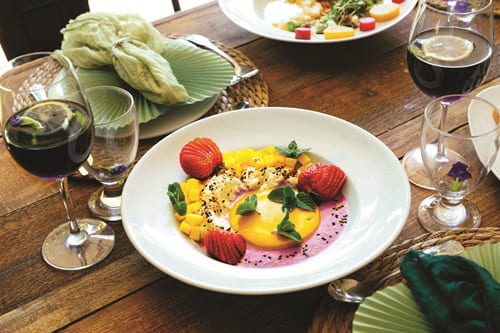
Depending on the style and the level of the event that we're doing, we'll either do a plated appetizer or a salad course. Our mango rosewater sorbet dish is an intermezzo course (a light, refreshing bite served between courses to provide a moment of pause and prepare the taste buds for the next dish), so we send it out to the table to cleanse the palate. Then we'll do our entrees, normally some sort of protein themed around a particular cuisine. We've done everything from French, Thai, Moroccan, Mediterranean and Greek. We like to try to offer different varieties and things that people maybe haven't experienced before, utilizing what’s in season.”
He shares that he tries to offer a brief explanation to diners between each course for context.
“I'll come and introduce and explain the dish and the cultural relevance of it,” Crossman advises. “We recently did a Silk Road dinner, so we had six courses that emphasized different elements of Turkish and Chinese cuisine and certain communities that were there in those time periods—what they ate and the inspiration for the dishes.”
Saturday night dinners are open to the public, accommodating up to 60 people. They also rent the farm out for private events.
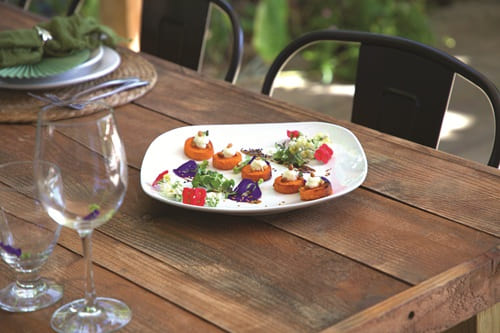
Next, we sample the sweet potato medallions, which are sweet, earthy and melt in your mouth.
“These are an individual bite to start off the meal,” he says. “This is something traditionally you'd see as one of our first course appetizers, something small, something a little bit involved in terms of the plating. I like to lean into culinary gastronomy elements a lot. The sweet potatoes we actually grew and harvested here at the farm. We have some moringa blossoms and butterfly peas here. We locally source some of our microgreens from a couple of different vendors in the area. We do our best to grow as much as we can here and everything in the garden is edible. We also source from others in the area to ensure we're staying local and provide needed revenue for farms and entrepreneurs.”
From there, we move on to the beet salad.
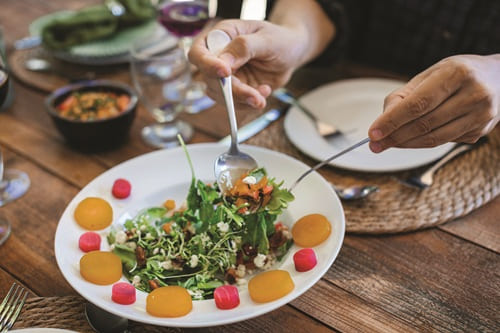
“Here we have golden beets and peppermint beets, a little bit of arugula, candied pistachios, goat cheese, some of our microgreens and Bartlett pears ,” Crossman explains. “I made a mustard, maple, apple cider vinaigrette that goes with it. This is one of my favorite things to prepare and has a lot of good memories for me.”
His early memories are also centered around food.
“I'm one of the lucky few that has known for just about my entire life that this is what I wanted to do. I started washing dishes when I was just a wee lad, before I probably should have. As soon as I could get to work, I was working,” he recalls. “I worked in a breakfast place and was able to develop a lot of my core skills there. After that, I worked in pizza places, yacht clubs, country clubs and then slowly just kind of got more notches under my belt. My family has always been in the restaurant industry, even our extended family back in Greece.
My father passed away from leukemia when I was 5 years old,” he continues, reflectively. “I grew up with just my mom and my three sisters. When I was a teenager, I would gravitate towards my favorite things in my mother's kitchen, the beat-up wooden handle knife or the cutting board. Then I learned that these were things my father loved to cook with.”

Seeding Connection
We move from meaty topics to meaty dishes. The farm has a way of encouraging sharing and food is the catalyst for connection.
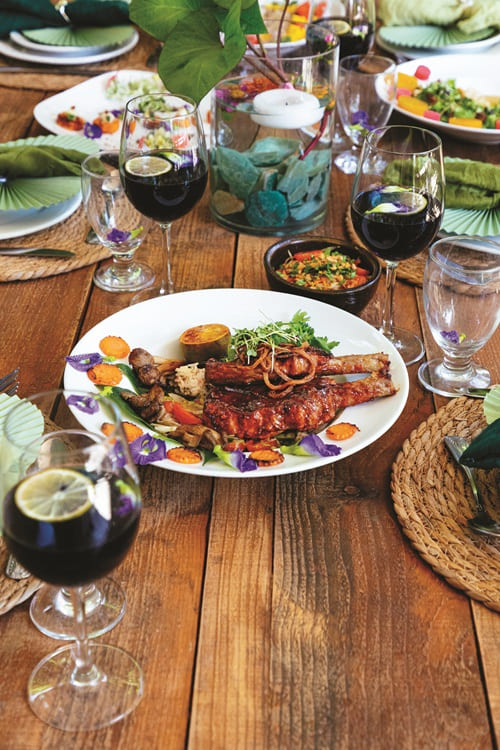
“Here’s our bone-in pork loin, seared, coated in a black bean hoisin sauce and blasted in the oven to kind of get some of that nice crackly element to it. We have some braised oyster mushrooms, some long beans, a little bit of cabbage and tomatoes. Then we have sesame seaweed flavored rice on the outside and then we have our papaya salad, which is one of my favorite things. You have the acidity in there, the garlic—a little bit of the sweet and savory.”
I press him further about the genuine camaraderie and unguarded connection a visit to the farm seems to inspire, as we indulge in the symphony of flavors before us.
“People are always surprised about kind of the environment that we've developed here,” Crossman shares. “Whether it's the team, the volunteers or the community, everybody puts their best foot forward in terms of helping, developing and wanting to become a part of it. We're a network of individuals that are all about supporting each other. It’s about developing the community and making sure that everyone always feels welcome and understood.”

Pericles and Crossman then take turns conveying the story of a young man who came to the farm as part of a program with another nonprofit.
“He was a part of a workforce program with the Boley Centers, which help individuals gain skill sets they wouldn't gain without employment,” Pericles explains.
“We mentor them and try to teach them,” Crossman offers. “So that after they get out of high school, they're ready to hit the workforce. A lot of times it's showing them a little inspiration and the different world we have here on the farm.”
“Emmanuel said to him one day, ‘We have to go to this business meeting. We would like you to come with us, so you can see what these meetings are like.’” Pericles recalls. “He goes and a lady at the table asks him, ‘What are you learning at the farm?’ And he said, ‘I'm learning to be of value to others.’ That's a 17-year-old boy and that's what he took away.”
We leave with plenty of food for thought. If it all sounds a bit idyllic, that’s because it just may be. And this farm-to-table tale, unlike the previously mentioned Times story, has a happy ending rooted in goodness and resulting in a harvest of community connections.
Visit 15thstfarm.com to learn more.