In today’s digital age, when something piques our curiosity, we often tumble down a proverbial rabbit hole, scouring the web and consuming every available source of public content on the topic—until we’ve either exhausted the material or ourselves. Along the way, we assemble a mental mosaic—fragments from countless sources forming a composite image of something or someone. What follows is a pastiche of Cristi López’s reflections and insights, drawn from her telling of her own compelling story.
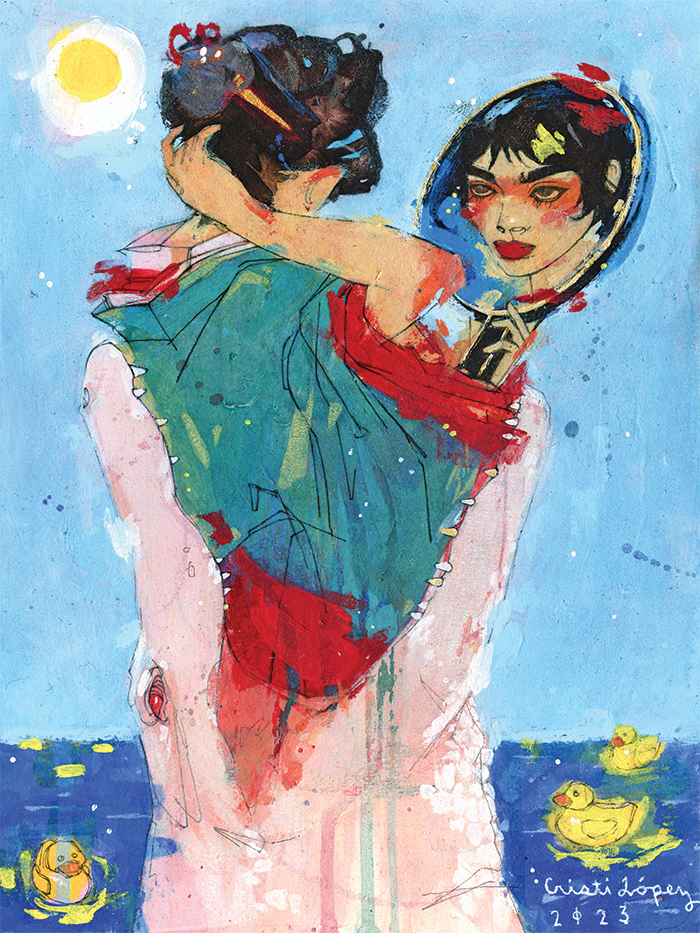
If you haven’t heard of her yet, López is an artist gaining attention for her sensuous, psychologically layered works that explore the complexities of identity through bold color palettes and intriguing compositions.
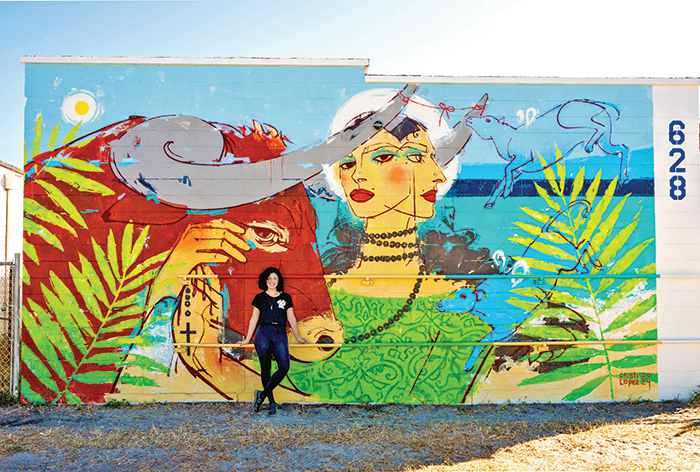
Her first local mural, titled Moo, is located at 2655 Fairfield Ave South, and was created as part of the 10th annual SHINE Mural Festival in November of last year. Full of subtle symbolism, the composition celebrates femininity and our connection to the natural world, whimsically incorporating cows—her favorite animal.
“Creating something that will be part of people’s everyday lives—the unique way that murals are—is very special,” López explains. “One of SHINE’s stated intentions is to make St. Pete into an open-air gallery, and that’s exactly what they’ve done. St. Pete’s walls have made the city a gallery that you live in. It’s a dream!”
A first-generation American of Dominican, Spanish and Cuban descent, she grew up in Florida and earned a BFA in Illustration from Ringling College of Art and Design. She staged her first solo show in Chicago before returning to Florida and settling in St. Pete. Her larger body of work explores the tension between her traditional heritage and modern identity, including themes of sexuality, femininity and mental health.
“Latin American culture is collectively lacking in its acknowledgement of mental illness. This has had ramifications in my own life and the lives of multiple family members, some of whom did not survive their battles. It took me 25 years to be diagnosed with Obsessive Compulsive Disorder (OCD) after a lifetime of struggle,” she reveals. “As an artist, I feel compelled to create sapphic dreamscapes. I can’t necessarily explain why, but I create them anyway…because the images come naturally to me. I am also compelled to love women, but my anxious mind generates reasons why I shouldn’t. Naturally, the stakes do feel quite high. My culture and religion of origin also isn’t keen on homosexuality. But trying to get to the bottom of why my OCD attacks my sexuality is a trap; especially when my OCD attacks everything from my favorite color to my choice of socks.”
Described as incorporating allegorical, surreal and often abstracted elements, her work reveals itself as both a search for a visual language to articulate the reality of her condition and an act of exorcising her inner demons. She uses it as a platform to amplify the lived experiences of those with mental illness—encapsulated in one of her favorite mantras, To be portrayed is to be seen.
“My work illustrates the often-invisible journey of navigating mental illness. I aim to remind others that their unique, complex journeys deserve to be acknowledged without judgment,” she offers. “The neurodivergent mind is not to be relegated to the shadows; it is to be explored in full color.”
She seeks to foster a deeper understanding of the emotions, complexity, and creativity inherent in people with OCD—not to focus solely on their challenges, but to portray them as whole, multifaceted individuals beyond their condition.

“When I was younger, I over-identified with my negative thoughts, rationalizing their presence as an indication of dark truths about me. I looked at whatever my current experience was through the lens of this negative self-talk. It poisoned most everything I did, felt and said. This included my accomplishments, which were confusingly tinged with the same painful self-doubt as my perceived failures.
When I was 20, my therapist encouraged me to try reframing my sensitivity by reading Elaine Aron’s The Highly Sensitive Person. This was the first time I saw sensitivity painted as a potentially positive, even powerful, trait. I can’t count the number of times in my life that my sensitivity has been cited as a problem, an inconvenience and something to be remedied,” she continues. “The traits I possess that were reinforced and encouraged by the school system included perfectionism, rigidity, structure…things that made me a model student. Both structure and creativity are integral to a balanced life, but—aided by the all-or-nothing tendencies of OCD and cultural messaging—I overdeveloped the structured parts of myself to the point where I was incapacitated.”
She eventually learned to channel the negative feedback loops and hypersensitivity through a program she entered for treatment of her OCD and complex anxiety disorders. Exposure and response prevention therapy (ERP) was a substantial part of her treatment. According to the International OCD Foundation, the “exposure” in ERP refers to intentionally exposing yourself to the thoughts, images, objects and situations that generate anxiety and obsessive thinking. The “response prevention” in ERP refers to consciously not engaging in compulsions/rituals to mitigate the anxiety.
“Creating art is an excellent exercise in learning how to tolerate the discomfort of uncertainty. The prospect of sitting with our own critical thoughts, that often arise—even if you don’t have OCD—can be enough to keep us from doing it at all. We not only expect our creation to look like something recognizable, we also expect it to be good,” López asserts. “When I was in the depths of my disorder, I remember that the idea of creating art felt impossible. At that point, I felt like I succeeded if I took a shower, so how the hell was I going to create a masterpiece?”
She shares that one of the more impactful mantras she has incorporated into her routine is simply, “good enough.”
“As a recovering perfectionist, these words are deeply uncomfortable to articulate and practice,” she confesses. “But as anyone managing OCD knows, discomfort is where growth occurs. So, I sit with the thought, feel the anxiety and trust that it will run its course. It just takes practice.”
López hosts the “Queer Contours” figure drawing series in collaboration with Queer Expression St. Pete and teaches yoga at SukhaLife Yoga Studio. Visit cristilopezart.com to learn more.